INT. GALLERY ROOM — HORROR · SHADOW GALLERY — DAY
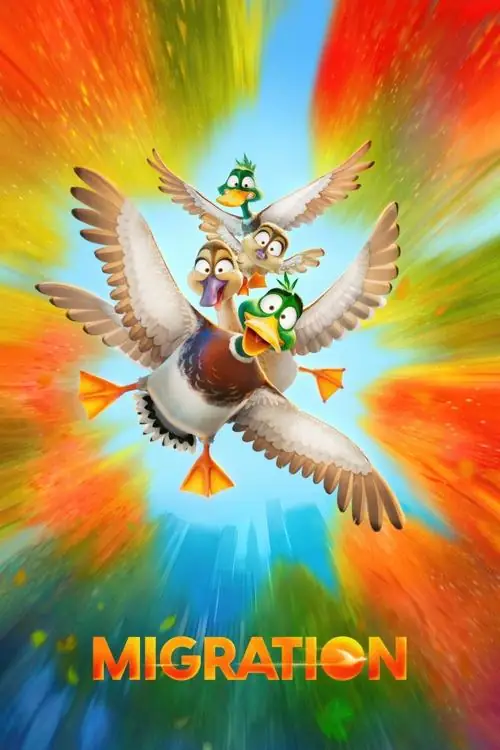
Benjamin Renner's 'Migration,' produced by Illumination Entertainment and released in 2023, represents a significant inflection point for a studio whose brand identity has been largely defined by the 'Despicable Me' franchise and its Minion-adjacent spin-offs. Renner, the French animator whose previous features—including the Oscar-nominated 'Ernest & Celestine' and 'The Big Bad Fox and Other Tales'—demonstrated a commitment to the hand-drawn tradition and a sensibility rooted in European comic art, brings to this computer-animated family adventure a visual elegance and emotional restraint that distinguishes it from the studio's more frenetic output. The narrative follows the Mallard family, a clan of ducks whose patriarch, Mack, has constructed a life of anxious predictability around the small New England pond that is the only world his children have ever known. When a family of migrating ducks descends upon their pond with stories of distant, sun-drenched lands—tropical Jamaica, with its turquoise waters and mango trees—the Mallard children are seized by a longing for adventure that Mack, whose every instinct is oriented toward the avoidance of risk, must struggle to understand and, ultimately, to embrace.
The film's visual design represents a deliberate departure from the Illumination house style, incorporating influences from Renner's background in European illustration and the tradition of the ligne claire that runs from Hergé through the great Franco-Belgian comic artists. The ducks themselves are rendered with a simplified, almost graphic quality that emphasizes their expressive potential without sacrificing the physical comedy that is essential to the film's appeal. The environments, by contrast, are treated with a painterly attention to atmosphere and light that elevates the road-trip structure into something approaching the sublime: the autumnal forests of New England, rendered in a palette of russet, amber, and gold; the vertiginous canyons of New York City, where the ducks' tiny forms are dwarfed by skyscrapers that seem to pierce the heavens; the lush, saturated greens of the Jamaican jungle, where the light itself seems to have a different quality, thicker and sweeter than anything the Mallards have ever known. This visual journey, from the familiar to the exotic and back again, is structured as a series of set-pieces that function as both comic showcases and character beats, each new environment demanding a different kind of courage from the ducks and revealing new dimensions of their relationships to one another.
CUT TO: THE WORK UNFOLDS
At its thematic core, 'Migration' is a film about the tension between security and adventure, between the comfort of the known and the terror—and exhilaration—of the unknown. Mack's journey from fearful overprotectiveness to a more expansive understanding of what it means to be a good parent is rendered with a psychological nuance that is rare in animated family entertainment. The film does not suggest that his caution is entirely misguided—the world is, after all, full of genuine dangers, and the ducks encounter predators, both animal and human, that justify his worst fears—but it insists that a life lived entirely within the confines of safety is not really a life at all. The relationship between Mack and his wife Pam, voiced with warmth and intelligence, provides the film with its emotional anchor, a portrait of a marriage in which the partners must learn to accommodate each other's different orientations toward risk and reward. The children—the adventurous Dax and the wide-eyed Gwen—are rendered not as miniature adults but as recognizably childlike beings whose curiosity and vulnerability exist in productive tension. The film's final act, in which the ducks must deploy all the skills they have acquired on their journey to save one of their own, provides a satisfying narrative payoff that is also a statement of theme: the experiences that terrify us are also the experiences that equip us. In a cinematic landscape increasingly dominated by franchise obligations and algorithmic calculation, 'Migration' feels like a genuine act of creative conviction, a film that trusts its audience—children and adults alike—to follow it into unfamiliar territory.
Source Reference
Original archive log: https://www.themoviedb.org/movie/940551?language=en-US