INT. GALLERY ROOM — NOIR · SHADOW & SMOKE — DAY
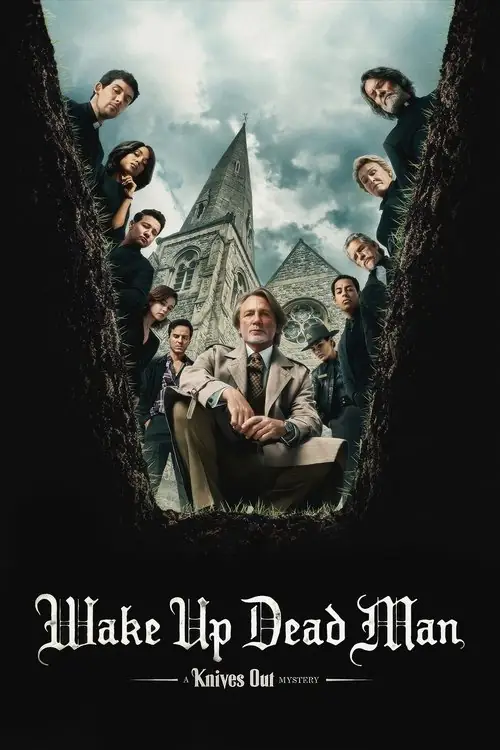
Rian Johnson's third outing with the drawling, sartorially impeccable detective Benoit Blanc plunges the franchise into ecclesiastical territory, trading the gleaming modernist interiors of the previous installments for the candlelit recesses of a small-town parish. The film opens with the arrival of a young priest, Jud Duplenticy, dispatched to serve under the charismatic Monsignor Jefferson Wicks—a figure whose magnetic presence seems to command the very atmosphere of the sanctuary. The screenplay wastes no time establishing the currents of unease that ripple beneath the surface of congregational life, building a foundation of institutional tension before the narrative pivots into the territory of the seemingly impossible. The murder that catalyzes the investigation is presented with Johnson's characteristic flair for the locked-room puzzle: a death that defies immediate explanation, occurring under circumstances that appear to preclude any conventional perpetrator. Chief Geraldine Scott, the local police authority, demonstrates the franchise's ongoing commitment to populating its world with figures of genuine intelligence rather than the bumbling law enforcement caricatures that lesser mysteries deploy. Her decision to summon Blanc reflects not incompetence but a clear-eyed recognition of the case's peculiar dimensions, and the film grants her a dignity that makes her eventual partnership with the detective feel like a meeting of equals rather than a condescension. Johnson's direction continues to exhibit the formal playfulness that has become his signature: the camera glides through the ecclesiastical architecture with a fluidity that transforms the church into a character in its own right, its confessional booths and choir lofts and vestry corridors becoming the terrain of a theological chess match. The film's engagement with religious themes is neither dismissive nor devotional; it treats the church as a human institution, complete with its own hierarchies, vanities, and carefully guarded secrets. Blanc's investigation peels back the layers of parish life with the same methodical precision he brings to any case, but there is something newly contemplative in his approach—a recognition that the mysteries of faith and the mysteries of homicide are not entirely unrelated inquiries. The screenplay's architecture is a marvel of narrative engineering, planting clues and character details throughout the early scenes that pay off with devastating precision in the final act. Johnson's great gift as a mystery writer is his understanding that the most satisfying solutions are not those that merely resolve the plot but those that illuminate character, that reveal the solution to the crime to be inseparable from the solution to the human equation that produced it. The ensemble cast navigates the tonal shifts—from comedy to menace to genuine pathos—with the assurance of performers who understand that Johnson's world rewards precision above all. Wake Up Dead Man confirms that the Knives Out franchise has evolved into something rarer than a mere series of whodunits: it has become an ongoing anatomy of the American condition, conducted through the lens of its most elegant and eccentric detective.
Source Reference
Original archive log: https://www.themoviedb.org/movie/812583?language=en-US