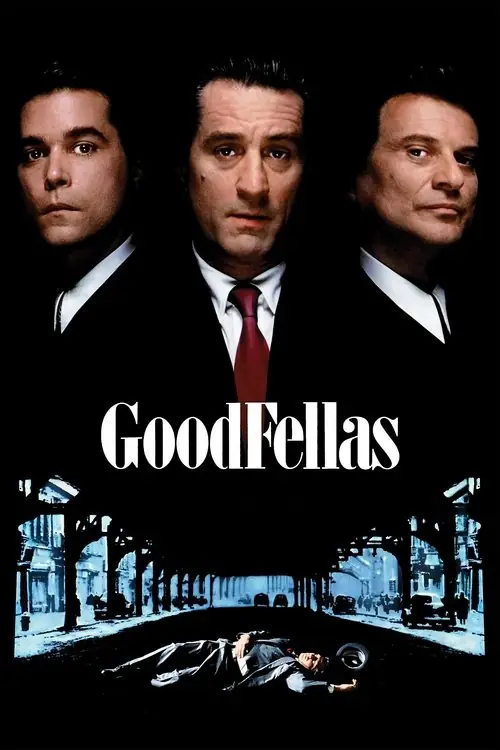
INT. GALLERY ROOM — NOIR · SHADOW & SMOKE — DAY
Martin Scorsese's 1990 masterwork stands as one of the monumental achievements in American cinema, a kinetically charged chronicle of Mafia life that dismantles the romantic mythology of the gangster genre with surgical precision and operatic fervor. Adapted by Nicholas Pileggi from his own nonfiction account of Henry Hill's trajectory through the Lucchese crime family, the film deploys a formal vocabulary of breathtaking virtuosity: the legendary Copacabana tracking shot—a continuous, three-minute Steadicam glide through back corridors and into a nightclub—functions not merely as a technical showpiece but as a visual metaphor for the seductive, seamless access that organized crime offers its initiates. The camera, wielded by cinematographer Michael Ballhaus, moves with the swaggering confidence of the characters it observes, employing freeze-frames, whip pans, and sudden zooms that fracture the narrative surface and mirror the cocaine-fueled paranoia of the film's second half. Scorsese's editing strategy, executed in collaboration with the incomparable Thelma Schoonmaker, creates a propulsive, jazz-like rhythm that compresses decades into a breathless montage while simultaneously allowing individual moments of violence to detonate with shocking, lingering impact.
The thematic architecture of GoodFellas is built upon the tension between the allure of belonging and the corrosive reality of life lived outside the law. Ray Liotta's Henry Hill serves as our conduit into this world, his wide-eyed narration laced with genuine wonder at the material privileges and fraternal bonds that organized crime initially affords. The film's genius lies in its refusal to moralize from a distance; instead, it immerses the viewer so completely in the seductive texture of mob life—the crisp suits, the tableside deference, the immunity from pedestrian consequence—that the gradual descent into betrayal, addiction, and spiritual bankruptcy registers as a genuinely sickening fall. Joe Pesci's Tommy DeVito, a performance of such coiled, unpredictable menace that it earned a well-deserved Academy Award, embodies the terrifying capriciousness at the heart of the enterprise, a man whose capacity for psychopathic violence coexists with a desperate need for approval and respect. Robert De Niro's Jimmy Conway, by contrast, projects a chillingly pragmatic intelligence, his calculations always running beneath a surface of avuncular charm.
CUT TO: THE WORK UNFOLDS
Scorsese's Catholic sensibility, a throughline across his entire oeuvre, manifests here in the film's structural resemblance to a morality play stripped of redemptive possibility. The sacramental rhythms of family dinners, baptisms, and weddings are intercut with acts of brutal violence, the juxtaposition suggesting not hypocrisy but rather a genuinely integrated worldview in which brutality and piety are not contradictory but complementary. The soundtrack, a brilliant tapestry of popular music spanning doo-wop, British Invasion rock, and piano-driven singer-songwriter confessionals, functions as a Greek chorus, with each needle drop precisely calibrated to comment on the action or to evoke the cultural texture of a specific era. The film's final act, set in a single frenzied day as Henry's cocaine empire collapses around him, achieves a paranoiac intensity that remains unmatched in American cinema, Scorsese's camera finally coming unmoored as the protagonist's grip on his double life disintegrates. GoodFellas endures not merely as a crime film but as a profound examination of the American appetite for wealth, status, and belonging, and the spiritual void that awaits those who pursue these goals through the sacrament of violence.
Source Reference
Original archive log: https://www.themoviedb.org/movie/769?language=en-US