INT. GALLERY ROOM — ACTION · MOVING FRAMES — DAY
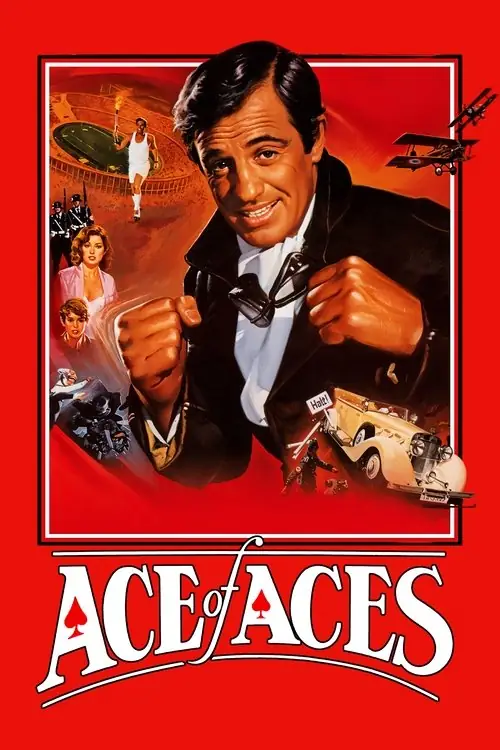
Gérard Oury's 1982 action-comedy 'Ace of Aces' ('L'As des as') stands as one of the most tonally audacious films in the French popular cinema canon, a work that dares to locate broad physical comedy and swashbuckling adventure within the shadow of the 1936 Berlin Olympics and the gathering storm of Nazi persecution. Jean-Paul Belmondo, at the apex of his charismatic powers, portrays Jo Cavalier, a French boxing coach whose journey to the Olympic Games aboard a train bound for the German capital is interrupted by an encounter with a young Jewish boy, Simon Rosenblum, whose innocent request for an autograph will ultimately derail every ambition the boxer has nurtured. The film's genius—and its audacity—lies in its refusal to compartmentalize tone: one moment we are in the realm of pure slapstick, with Belmondo's physical dexterity and expressive face generating the kind of laughter that comes from deep in the belly; the next, we are plunged into the visceral terror of a child facing the machinery of the Nazi state, and the comedy curdles into something far more urgent. Oury, a Jewish filmmaker who had himself fled occupied France during the war, brings to the material a personal understanding of the stakes at play that prevents the comedy from ever feeling glib or exploitative.
The film's visual language is a study in productive contrasts. The early sequences aboard the train, with their warm, wood-paneled interiors and the gentle rhythm of the rails, establish a tone of nostalgic adventure cinema that deliberately evokes the spirit of the pre-war era. The arrival in Berlin, by contrast, is marked by a shift toward a colder, more geometric visual register: the monumental architecture of the Nazi state, the relentless symmetry of the Olympic stadium, the ubiquity of the swastika rendered in blood-red banners that seem to bleed into the very fabric of the city. Cinematographer Jean Tournier captures this visual schism with a keen eye for the way ideology inscribes itself on the built environment. The boxing sequences themselves are choreographed not as realistic athletic contests but as balletic expressions of character, with Belmondo's physical performance—all coiled energy and explosive release—serving as a metaphor for the resistance that the film's narrative enacts against the forces of hatred and conformity.
CUT TO: THE WORK UNFOLDS
What elevates 'Ace of Aces' above the category of mere entertainment is the depth of its humanism and the complexity of its moral universe. The German officer who becomes Cavalier's ally, a veteran of the First World War, is not presented as a simple 'good German' but as a man whose adherence to an older code of military honor places him in existential conflict with the regime he serves. The relationship between these two men, forged in the crucible of a previous war and tested in the crucible of the one to come, provides the film with its emotional spine. The escape sequence that constitutes the film's extended climax—a breathless, geographically improbable dash toward the Swiss border with Nazi soldiers in pursuit—is orchestrated with the clockwork precision of the finest adventure cinema, yet it never loses sight of the human stakes that make the chase matter. Belmondo, who famously performed his own stunts, brings to these sequences a physical authenticity that grounds the film's more extravagant moments in a tangible reality. In the broader context of French cinema's reckoning with the Occupation and the Holocaust, 'Ace of Aces' occupies a unique position: it is neither the somber moral inquiry of a Resnais nor the myth-making of a Melville, but a popular entertainment that, through the alchemy of comedy and courage, arrives at a truth about human decency that is no less profound for being delivered with a smile. The film's final image—a freeze-frame of Belmondo's face, caught between exhaustion and triumph, terror and relief—is a masterclass in how genre cinema can, in its finest moments, transcend its own limitations and touch something universal.
Source Reference
Original archive log: https://www.themoviedb.org/movie/71524?language=en-US