INT. GALLERY ROOM — SCI-FI · TOMORROW'S FRAME — DAY
This contemplative Vietnamese drama unfolds as a meditation on memory, inheritance, and the spectral persistence of the past in a nation still negotiating the terms of its own history. The narrative weaves together two parallel threads: a middle-aged woman who receives a pygmy slow loris—a creature of haunting, wide-eyed stillness—from the husband she has long been separated from, and her niece, a young woman on the cusp of marriage whose impending union prompts her and her fiancé to confront the grim economic realities awaiting their generation. These two storylines, seemingly disparate, are bound together by the film's deeper inquiry into what it means to carry forward the burdens and blessings of those who came before. Director Pham Ngoc Lan, working in the tradition of slow cinema that has become a hallmark of Southeast Asian art-house filmmaking, employs a formal vocabulary of extended takes, meticulous composition, and a near-total absence of non-diegetic music, creating a viewing experience that demands patience and rewards it with moments of extraordinary visual poetry.
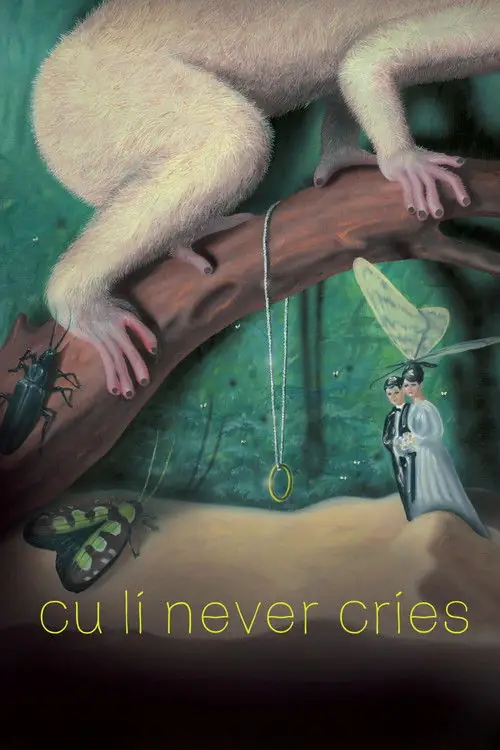
The pygmy slow loris at the center of the film operates as a creature of extraordinary symbolic resonance. With its deliberate, almost meditative movements and its large, perpetually watchful eyes, the animal becomes a living embodiment of the past that refuses to release its grip on the present. The woman's relationship with this unexpected inheritance—she must learn to care for it, to feed it, to accommodate its nocturnal rhythms—mirrors her relationship with her own memories, which demand similar forms of attention and accommodation. The film's cinematography treats the loris with a reverence bordering on the sacred, isolating it in pools of soft light against dark backgrounds, as though the creature has stepped out of a dream or a half-remembered folktale. The animal's famed inability to produce tears—the biological fact that gives the film its title—becomes a metaphor for a particular mode of survival, a way of enduring that refuses the catharsis of weeping in favor of a quieter, more persistent form of bearing witness.
CUT TO: THE WORK UNFOLDS
The parallel narrative of the niece and her fiancé introduces a different temporality into the film's structure: the future tense of young love confronting the hard data of economic precarity. Their conversations about marriage are shot through with anxiety about housing costs, job prospects, and the erosion of the social safety nets that supported previous generations. The director refuses to sentimentalize their predicament, presenting their fears not as obstacles to be overcome by love's redemptive power but as structural conditions that love must learn to coexist with, like weather or gravity. This clear-eyed materialism gives the film a bracing quality that prevents it from drifting into nostalgic reverie. The young couple's tentative plans for the future are rendered with a specificity—apartment dimensions, salary figures, the logistics of daily commuting—that grounds their story in the unglamorous reality of contemporary Vietnamese urban life.
The film's most remarkable achievement is its formal integration of personal and historical memory. The director employs a visual strategy that moves between the present-tense realism of the two women's daily lives and more abstract, associative sequences that seem to arise from the collective unconscious of the Vietnamese people. These passages—shot in a different register, with a different rhythm—suggest that the past is not merely recalled but actively present, saturating the physical world with meanings that predate and exceed individual experience. The title's assertion that the slow loris never cries becomes, in this context, a statement about the nature of historical trauma itself: it may not weep, it may not announce itself with dramatic gestures, but it is always watching, always present, always waiting to be acknowledged. The film is a quiet masterpiece of postcolonial cinema, a work that understands silence not as absence but as a form of testimony, and that finds in the smallest of creatures a mirror for the largest of human questions.
Source Reference
Original archive log: https://www.themoviedb.org/movie/643776?language=en-US