INT. GALLERY ROOM — SCI-FI · TOMORROW'S FRAME — DAY
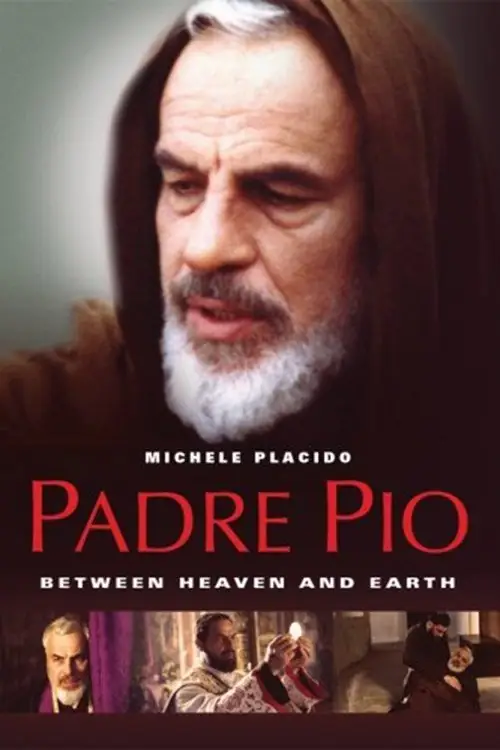
In the landscape of religious cinema, few subjects command the peculiar gravitational pull of Francesco Forgione, the Capuchin friar canonized as Padre Pio of Pietrelcina. This Italian television production navigates the treacherous terrain between hagiography and human portraiture with a restraint that distinguishes it from more saccharine devotional fare. The film trains its lens on the profound existential tension that defined Pio's earthly existence: a man simultaneously elevated by mystical communion with the divine and tormented by physical suffering, ecclesiastical suspicion, and the crushing weight of his own unwanted celebrity. The stigmata—those wounds that bled for half a century—are rendered not as sensational spectacle but as an intimate, almost clinical meditation on the body as a site of spiritual warfare. The director wisely resists the temptation to resolve the central paradox of Pio's life, instead allowing the mystery to breathe, to unsettle, to linger in the silences between scenes.
What distinguishes this treatment from countless other saint biographies is its willingness to engage with the institutional skepticism that dogged Pio throughout his ministry. The Vatican's investigators, the medical examiners who probed his wounds, the jealous confreres who whispered accusations of fraud—these figures are not caricatured as mustache-twirling antagonists but presented as earnest, if tragically limited, interlocutors. The film thus becomes a study in the friction between bureaucratic rationality and charismatic spirituality, between the Church as an institution of rules and the Church as a vessel for the ineffable. The screenplay finds its most potent moments not in grandiose miracles but in the quotidian rhythms of Pio's pastoral work: the interminable hours in the confessional, the letters written by candlelight, the quiet acts of tenderness toward the suffering pilgrims who flocked to San Giovanni Rotondo. This grounding in the materiality of devotion gives the film an emotional texture that transcends its modest production values.
CUT TO: THE WORK UNFOLDS
Visually, the filmmakers employ a muted, earthy palette that evokes the austere beauty of the Gargano region—limestone cliffs, olive groves, the stark geometry of the friary's corridors. The cinematography favors natural light and unadorned compositions, a formal modesty that mirrors Pio's own Franciscan simplicity. The sound design deserves particular mention for its nuanced treatment of silence, which becomes a kind of character in its own right, a sonic representation of the contemplative interiority that defined Pio's spiritual practice. The musical score, when it does surface, draws from the rich well of Italian sacred music tradition without ever tipping into sentimentality.
For cinephiles attuned to the intersection of faith and cinema, "Padre Pio: Between Heaven and Earth" offers a compelling entry in the tradition that stretches from Rossellini's "The Flowers of St. Francis" through Dreyer's "Ordet" to more contemporary works like Pawlikowski's "Ida." It understands that the most profound religious cinema is not that which seeks to convert but that which witnesses—that holds space for doubt, for darkness, for the terrifying possibility that the divine might actually be real. The film's portrait of Pio is ultimately a portrait of the twentieth century itself: a century of world wars and ideological convulsions, in which a stigmatic friar in a remote Italian village became, for millions, a sign of contradiction, a living argument that the material world is not all there is.
Source Reference
Original archive log: https://www.themoviedb.org/movie/549598?language=en-US