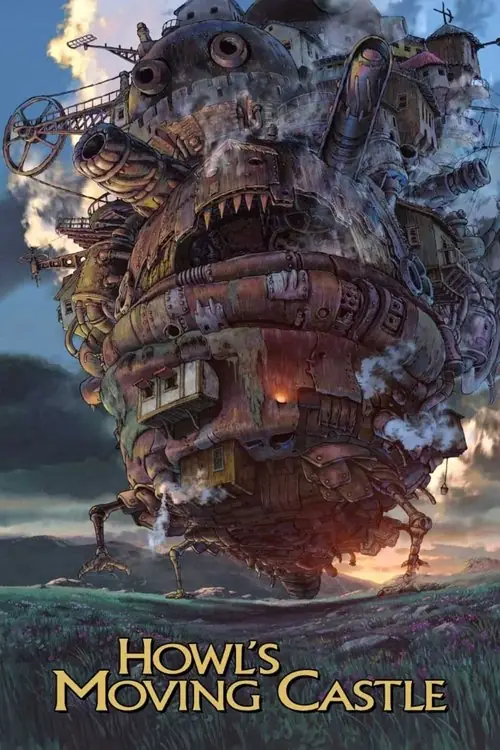
INT. GALLERY ROOM — SCI-FI · TOMORROW'S FRAME — DAY
Hayao Miyazaki's 2004 masterwork, adapted with characteristic liberty from Diana Wynne Jones's beloved novel, represents the apotheosis of the director's lifelong obsession with flight, transformation, and the moral catastrophe of war. The film opens with an encounter that encapsulates its thematic preoccupations in miniature: Sophie, a young milliner whose life has contracted into the narrow confines of her family's hat shop, is accosted on the street by leering soldiers and rescued by the enigmatic wizard Howl, who whisks her above the cobblestones of a vaguely Mitteleuropean city in a sequence of breathtaking aerial grace. This brief, transcendent flight—rendered in the hand-drawn animation that Studio Ghibli had refined to a state of near-religious perfection—is immediately followed by Sophie's cursing at the hands of the Witch of the Waste, who transforms her into a woman of ninety. The cruelty of this juxtaposition—the exhilaration of weightlessness followed by the crushing gravity of age—establishes the film's central dialectic between freedom and constraint, between the boundless possibilities of youth and the wisdom (and invisibility) of senescence.
What follows is among the most visually sumptuous and narratively labyrinthine journeys in the Ghibli canon. The moving castle itself, a wheezing, clanking, ambulatory pile of rusted metal, chimney stacks, and domestic detritus powered by the fire demon Calcifer, functions as a metaphor for the self that Miyazaki has spent a career exploring: a ramshackle contraption held together by will, love, and the mysterious energy of the heart. The castle's interior, a cozy domestic space that belies its chaotic exterior, represents the inner life that we construct against the chaos of the external world. Sophie's gradual acceptance of her aged form—and her discovery that the curse fluctuates in response to her emotional state, her confidence, her willingness to assert herself—transforms the film into a subtle and profound meditation on the relationship between identity and appearance, between the self we present to the world and the self we carry within. Miyazaki, working with longtime collaborator Joe Hisaishi, whose score achieves a melodic richness and emotional complexity that rivals the finest orchestral works of the late Romantic period, creates a sensory experience of almost overwhelming beauty.
CUT TO: THE WORK UNFOLDS
The film's anti-war subtext, which grows increasingly explicit as the narrative progresses, reflects Miyazaki's deep opposition to the American-led invasion of Iraq in 2003—a political context that the director has acknowledged in interviews. The war that ravages the film's unnamed kingdom is depicted not as a clash of ideologies but as an absurd, self-perpetuating machinery of destruction, prosecuted by interchangeable authority figures who issue their orders from the safety of ornate palaces while cities burn and civilians flee. Howl's refusal to participate in this conflict, his transformation into a monstrous bird-creature in his desperate attempts to sabotage the war machine, represents a form of resistance that is both heroic and self-destructive. The film's most radical gesture is its insistence that the true antagonist is not any individual villain—the Witch of the Waste is ultimately revealed as a figure of pathos, and the wizard Suliman is more bureaucrat than monster—but the system of war itself, a system that consumes the young and the beautiful and the gifted without ever achieving the peace it claims to pursue. The resolution, in which Sophie's love and courage restore Calcifer's freedom, break her own curse, and return Howl to his humanity, is earned through a narrative logic that is emotional rather than mechanical, a fairy-tale coherence that operates on the level of symbol and archetype. 'Howl's Moving Castle' is not merely one of the finest animated films ever made; it is one of the finest films, period, a work of art that demonstrates, with every frame, the capacity of the medium to encompass the full range of human experience.
Source Reference
Original archive log: https://www.themoviedb.org/movie/4935?language=en-US