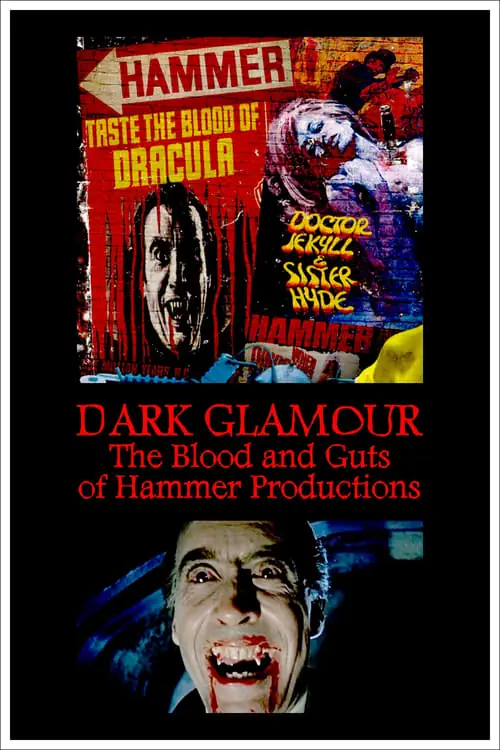
INT. GALLERY ROOM — HORROR · SHADOW GALLERY — DAY
This documentary examination of the legendary British production house Hammer Films operates as both a forensic historical inquiry and a rhapsodic celebration of a studio whose aesthetic imprint on horror cinema remains indelible. The filmmakers trace an arc from the company's postwar ascendancy through its golden period—roughly spanning the mid-1950s to the late 1960s—and onward into the twilight of its initial incarnation, constructing a narrative that positions Hammer as a uniquely British institution that simultaneously scandalized the establishment and captivated international audiences. The archival footage assembled here is genuinely revelatory, offering glimpses of the Bray Studios soundstages where the Gothic atmosphere was meticulously manufactured through painted backdrops, theatrical lighting techniques, and a vivid color palette that transformed modest budgets into immersive dreamscapes of dread. The documentary's editorial approach wisely avoids mere hagiography, instead engaging with the complex cultural legacy of a studio whose Gothic horrors frequently placed female characters in positions of exquisite vulnerability, a dynamic that contemporary scholarship rightly interrogates even as it acknowledges the operatic grandeur of the films themselves.
The aesthetic signature of Hammer—those saturated crimsons, the fog-choked graveyards, the baroque production design that made every drawing room feel like a chamber of secrets—receives careful attention from the commentators assembled here, who include surviving cast members, film historians, and contemporary directors who cite Hammer as a foundational influence. The documentary is particularly astute in its analysis of how the studio's visual language drew upon the traditions of British theatrical melodrama and the Grand Guignol, filtering these influences through the lens of Technicolor cinematography to create a mode of horror that was simultaneously lurid and elegant. The recurring casting of Peter Cushing and Christopher Lee emerges as the studio's masterstroke, their contrasting performance styles—Cushing's coiled, cerebral intensity versus Lee's towering, magnetic physicality—generating a dialectical energy that elevated even the most formulaic screenplays into compelling psychological theater.
CUT TO: THE WORK UNFOLDS
What elevates this documentary beyond standard behind-the-scenes fare is its willingness to situate Hammer within the broader currents of British cultural history. The filmmakers draw connections between the studio's transgressive content and the gradual erosion of Victorian moral strictures in postwar Britain, suggesting that Hammer's Gothic nightmares functioned as a kind of cultural pressure valve through which audiences could safely confront anxieties about sexuality, class dissolution, and the collapse of imperial certainty. The segment addressing the studio's fraught relationship with the British Board of Film Censors is particularly illuminating, revealing how the creative team's ingenuity in circumventing restrictions often resulted in films that were more suggestive and psychologically resonant than the explicit gore they were forbidden from depicting. The documentary's final movement, which traces Hammer's eventual decline and its twenty-first-century revival, rounds out a portrait that is as much about the tenacity of a particular artistic vision as it is about the mechanics of a film production company. For anyone interested in the intersection of genre cinema, national identity, and the evolution of screen horror, this documentary proves an essential and deeply rewarding viewing experience.
Source Reference
Original archive log: https://www.themoviedb.org/movie/470084?language=en-US