INT. GALLERY ROOM — SCI-FI · TOMORROW'S FRAME — DAY
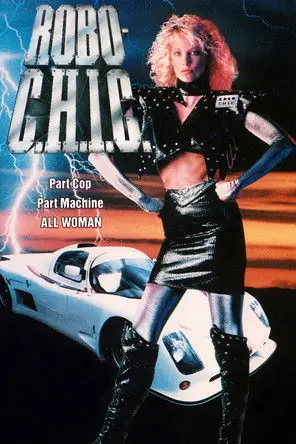
A delirious artifact from the direct-to-video era of the late 1980s, Cyber-C.H.I.C. occupies a peculiar niche in the taxonomy of exploitation cinema—a film so committed to its preposterous premise that it achieves a kind of accidental surrealism. The narrative framework is as unapologetically absurd as it is efficient: a megalomaniacal villain holds the planet hostage for a billion-dollar ransom, plunging civilization into anarchic chaos, and humanity's only hope is a Computerized Humanoid Intelligence Clone—a synthetically engineered female warrior whose combat capabilities are matched only by her improbable physical attributes. The film operates at the intersection of late-Cold War techno-paranoia and the burgeoning direct-to-video market that would define genre cinema for the next decade.
The aesthetic vocabulary of Cyber-C.H.I.C. draws shamelessly from the visual lexicon of its era—neon-drenched urban decay, shoulder pads that could double as architectural elements, and a synth-heavy score that pulses with the anxious energy of a culture simultaneously terrified of and intoxicated by the technological future. The film's protagonist, Robo C.H.I.C., embodies a particular fantasy of female power that is both regressive and strangely transgressive: she is an object of desire rendered as an instrument of destruction, her body weaponized in ways that simultaneously satisfy and subvert the male gaze. The contradiction is never resolved, and perhaps that unresolved tension is precisely the point.
CUT TO: THE WORK UNFOLDS
What elevates the film beyond its obvious limitations is its unwavering commitment to its own internal logic. There is no winking at the audience, no ironic distance, no self-conscious acknowledgment of the material's inherent ridiculousness. The film plays its cybernetic assassin with a straight face, investing her with a kind of mythic gravity that the script cannot quite justify but that the performance somehow earns. The action sequences, choreographed with the enthusiastic brutality characteristic of the period, demonstrate a physical inventiveness that transcends the budgetary constraints. Each confrontation is staged as a miniature ballet of destruction, the camera lingering on the aftermath of violence with a fascination that borders on the pornographic.
As a cultural document, Cyber-C.H.I.C. offers a fascinating window into the anxieties and fantasies of its historical moment. The film's preoccupation with artificial intelligence, bioengineering, and the militarization of the female body anticipates debates that would become central to popular culture in the decades to follow. The film's vision of a world held hostage by a lone madman resonates uncomfortably with contemporary concerns about asymmetric warfare and technological vulnerability. In this sense, the film functions as a kind of unconscious prophecy—a trash-culture artifact that accidentally stumbled onto the anxieties that would define the coming century. For scholars of genre cinema and cultural studies, it remains an essential, if deeply peculiar, text.
Source Reference
Original archive log: https://www.themoviedb.org/movie/42447?language=en-US