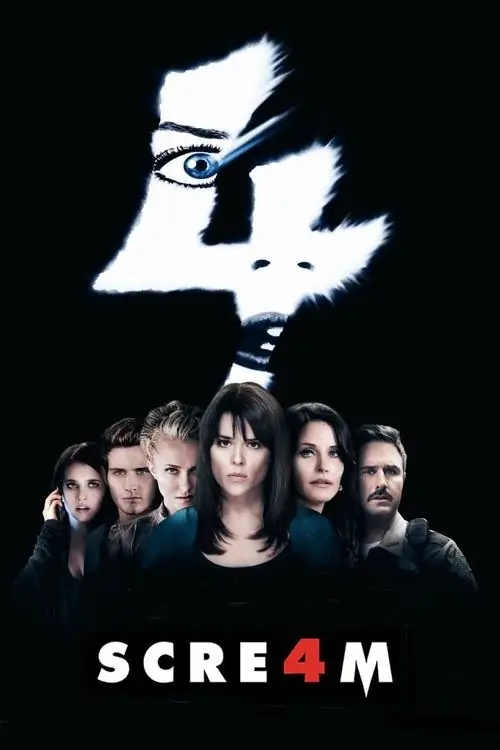
INT. GALLERY ROOM — HORROR · SHADOW GALLERY — DAY
When Wes Craven returned to the franchise he co-created with Kevin Williamson for a fourth installment, the cultural landscape had shifted dramatically from the milieu that birthed the original trilogy. The self-referential slasher that had once seemed so radical in its deconstruction of genre conventions now faced a cinematic ecosystem saturated with the very meta-textual gestures it had pioneered. "Scream 4" confronts this predicament head-on, transforming its own belatedness into its central thematic concern. The film is, at its core, a meditation on the reboot cycle, the voracious appetite of horror audiences for the same familiar rituals endlessly repackaged, and the particular cruelty of a culture that demands novelty while punishing deviation from established formulas. When Sidney Prescott returns to Woodsboro, she is no longer the traumatized final girl but a survivor who has metabolized her trauma into a published memoir—a woman who has done the work, only to discover that the work is never truly done.
The film's engagement with the technological and social transformations of the intervening decade is both canny and caustic. Where the original "Scream" used landlines and caller ID as instruments of terror, "Scream 4" weaponizes live-streaming, smartphone cameras, and the nascent culture of online fame-seeking. The new generation of Woodsboro teenagers does not merely fear Ghostface; they are, in a perverse sense, equipped to exploit the carnage for attention, their reflexive impulse to document horror supplanting any instinct to flee from it. This inversion—the victim as potential content creator—gives the film a satirical edge that cuts deeper than the franchise's previous self-reflexive maneuvers. The killer's motivation, when revealed, articulates a pathology that feels eerily prescient: the desire to achieve notoriety not through accomplishment but through the meticulous curation of a traumatic narrative, the belief that suffering, when properly framed and distributed, is a form of currency.
CUT TO: THE WORK UNFOLDS
Craven's direction demonstrates the economy and precision of a master who understands that horror is a fundamentally architectural genre. His staging of the set pieces—the parking garage sequence, the closet confrontation, the climactic hospital showdown—employs spatial logic with surgical exactitude, each doorway and window a potential vector of violence, each shadow a repository of dread. The cinematography, by Peter Deming, returns to the clean, almost classical compositions that distinguished the original, eschewing the shaky-cam affectations that had colonized horror cinema in the intervening years. The result is a film that feels simultaneously of its moment and defiantly classical, a slasher that understands that the most effective terror arises not from chaos but from the cruel geometry of inevitability.
For all its bloodshed and gallows humor, "Scream 4" is ultimately a film about the impossibility of closure. Sidney's arc across the quartet traces a devastating trajectory: the violence that defined her youth is not a chapter she can close but a shadow she must learn to walk beside. The film's final moments, ambiguous and unsettling, refuse the consolations of the traditional horror ending. In the franchise's taxonomy, "Scream 4" occupies a peculiar position—initially dismissed as an unnecessary appendage, it has aged into something more substantial, a work whose critique of remake culture and performative victimhood has only grown more pointed with time. It is a slasher film about the impossibility of escaping the slasher film, and in that recursive despair, it achieves a kind of tragic grandeur.
Source Reference
Original archive log: https://www.themoviedb.org/movie/41446?language=en-US