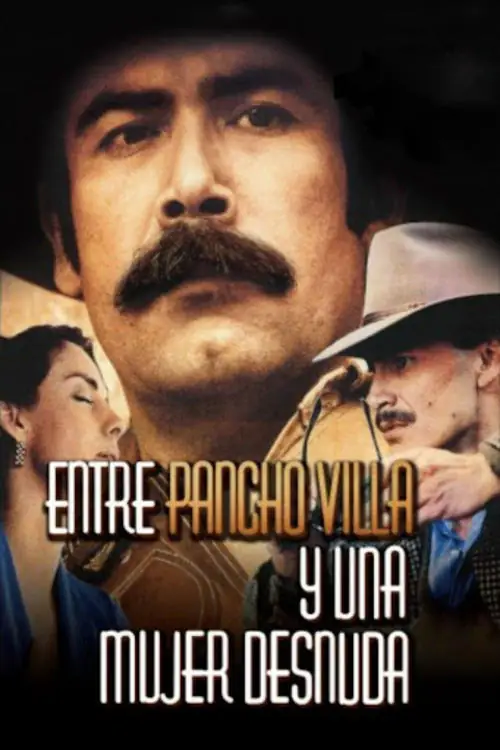
INT. GALLERY ROOM — SCI-FI · TOMORROW'S FRAME — DAY
Sabina Berman and Isabelle Tardán's cinematic adaptation of Berman's own stage play operates as a deceptively buoyant vehicle for a razor-sharp feminist excavation of Mexican revolutionary mythology. The narrative orbits around Gina, a woman navigating her late forties whose professional competence and urban sophistication coexist uneasily with an intermittent liaison with Adrián, a journalist whose intellectual fascination with Pancho Villa masks a more troubling identification with the revolutionary's domineering masculinity. The film deploys the figure of Villa—that most potent and contested of Mexican national symbols—as a prism through which to examine the deeply embedded structures of patriarchal power that survive, intact and largely unquestioned, beneath the surface of contemporary gender relations. What begins as a seemingly light romantic comedy gradually reveals itself as a work of sustained ideological critique, the humor serving not as escape but as a delivery mechanism for uncomfortable truths.
The film's formal architecture mirrors its thematic concerns with considerable sophistication. The temporal weave between the historical Villa and the present-day narrative is handled not as straightforward parallel but as a series of increasingly destabilizing intrusions. Villa materializes as a spectral presence—part historical figure, part masculine archetype, part projection of Adrián's identification—and his appearances grow progressively more charged as Gina's consciousness awakens to the patterns of domination she has internalized. The cinematography underscores this dialectic through a deliberate contrast between the warm, saturated tones of the historical sequences and the cooler, more desaturated palette of the contemporary scenes, suggesting that the past exerts a gravitational pull that distorts the present's self-understanding. The screenplay's handling of the Villa material resists both hagiography and simple condemnation, instead presenting the revolutionary's relationships with women as a site of irreducible contradiction—the liberator of a nation who could not liberate himself from the imperatives of machismo.
CUT TO: THE WORK UNFOLDS
At the emotional core of the film lies Gina's dawning recognition—rendered with remarkable subtlety by the lead performance—that the revolution she has been helping Adrián chronicle was never her revolution at all. The moment of this realization is staged not as melodramatic epiphany but as a quiet, devastating accumulation of evidence: the women in Villa's story are always instrumental, always secondary, always defined by their proximity to male agency. The film extends this insight into a broader meditation on the gendered exclusions embedded within revolutionary discourse itself, suggesting that the grand narratives of national liberation have consistently been authored by and for men, with women's emancipation perpetually deferred to some future moment that never arrives. The title's juxtaposition—placing the legendary Villa alongside the intimate specificity of "a naked woman"—encapsulates the film's central operation: to insist that the personal is not merely political but historiographical, that the bodies and desires excluded from official memory constitute a counter-archive demanding recognition.
Between Pancho Villa and a Naked Woman ultimately achieves something rare in politically engaged cinema: it entertains while it unsettles, and it unsettles without resorting to didacticism. The film's tonal agility—its capacity to shift from screwball banter to moments of genuine emotional devastation—demonstrates a sophisticated understanding that the structures of patriarchal power are most effectively challenged not through humorless polemic but through the defamiliarizing force of laughter turned against its traditional targets. The film leaves its audience not with the comfort of resolution but with the productive discomfort of questions that linger long after the credits roll: questions about whose stories get told, whose bodies matter, and what it would mean to imagine a revolution that truly included everyone.
Source Reference
Original archive log: https://www.themoviedb.org/movie/282413?language=en-US