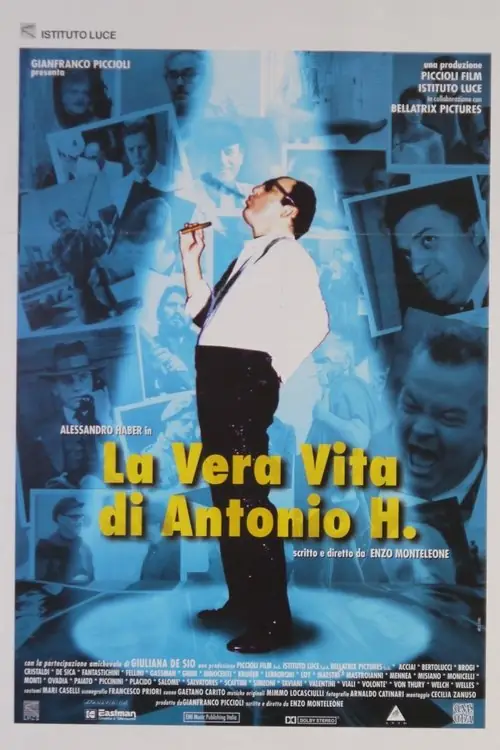
INT. GALLERY ROOM — SCI-FI · TOMORROW'S FRAME — DAY
Enzo Monteleone's The True Life of Antonio H. represents one of the more audacious experiments in the intersection of documentary and fiction—a film that dissolves the membrane between biography and autobiography, between the actor and the role, between the life lived and the life imagined. The subject is Antonio Hutter, a fictional thespian of considerable misfortune whose career trajectory mirrors, refracts, and distorts that of Alessandro Haber, the celebrated Italian actor who portrays him. The film's formal structure—a collage of interviews with real colleagues, archival footage, and improvised sequences—creates a hall-of-mirrors effect in which the distinction between reality and fabrication becomes not merely blurred but philosophically unsustainable.
The narrative traces Hutter's improbable journey from his birth in Bologna through a childhood spent in the Middle East—a geographical displacement that the film presents as foundational to his identity as a perpetual outsider—and into the volatile world of Italian theatre and cinema. Monteleone's approach to this material is deliberately unstable, shifting registers without warning. A sequence that presents itself as documentary testimony may suddenly reveal itself as scripted performance; a moment of apparent improvisation may disclose its origins in meticulous preparation. The film's refusal to stabilize its own ontological status is not a failure of clarity but a philosophical position: the claim that any life, when subjected to the pressure of narrative, becomes a species of fiction.
CUT TO: THE WORK UNFOLDS
Haber's performance—if performance is indeed the appropriate term for what he accomplishes here—is a tour de force of self-interrogation. By inhabiting a fictionalized version of himself, he creates a space in which the anxieties and vanities of the actor's life can be examined with a candour that would be impossible in a straightforward autobiographical mode. The film becomes a meditation on the actor's peculiar existential condition: the professional obligation to be someone else, the consequent erosion of a stable self, the perpetual performance that extends from the stage into every corner of private life. Haber's willingness to subject himself to this examination is both courageous and unsettling.
The film's cultural significance extends beyond its formal innovations. As a portrait of the Italian entertainment industry, it functions as a critique of the institutional structures that determine who gets to tell stories and under what conditions. The interviews with Haber's real colleagues—directors, fellow actors, producers—create a composite portrait of an industry that manufactures identities while simultaneously consuming them. The archival footage, drawn from Haber's actual career, acquires a haunting quality when juxtaposed with the fictional narrative: the real performances become evidence in a case the film is building about the nature of authenticity itself. The True Life of Antonio H. is a work of considerable intellectual ambition, and its rewards are commensurate with the demands it makes on its audience.
Source Reference
Original archive log: https://www.themoviedb.org/movie/265144?language=en-US