INT. GALLERY ROOM — SCI-FI · TOMORROW'S FRAME — DAY
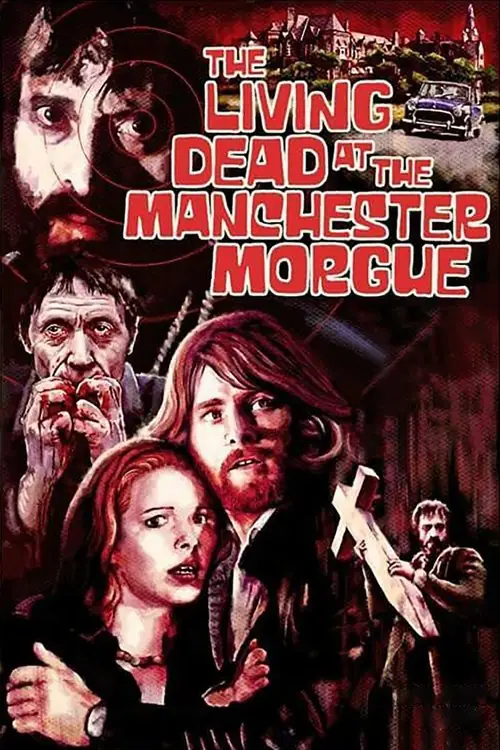
Jorge Grau's 1974 contribution to the zombie canon, released under a bewildering multiplicity of titles across different territories, occupies a distinctive niche within the undead subgenre, one that merits serious reappraisal beyond the cult-cinema ghetto to which it has often been consigned. The film transplants the living-dead mythology from its American roots to the misty, pastoral landscapes of the English countryside, a geographical relocation that transforms the zombie from a creature of suburban dread into a threat that desecrates a specifically British pastoral ideal. The narrative premise—a government agricultural experiment employing ultrasonic radiation as an insecticide inadvertently reanimates the recently deceased—cleverly integrates the zombie trope with contemporary anxieties about environmental degradation and scientific hubris, anticipating by several decades the eco-horror concerns that would become a dominant mode in twenty-first-century genre cinema. Grau, a Spanish director working within an Italian-Spanish co-production framework, brings a distinctly European sensibility to the material, his camera lingering on the textures of decay and the quiet horror of the English countryside slowly being poisoned by the invisible byproducts of modernity.
The film's visual strategy is built upon a rich dialectic between the bucolic and the grotesque. The Peak District locations, photographed by cinematographer Francisco Sempere with a sensitivity to the particular quality of northern English light—that gray, diffused radiance that seems to drain color from the landscape—are rendered as spaces of eerie, almost supernatural beauty before being systematically violated by the shambling presence of the resurrected dead. The undead themselves are designed with a restraint that distinguishes them from the more baroque creations of contemporaneous Italian zombie cinema; these are not the spectacularly decomposed revenants of Fulci's nightmares but rather the recently dead, their horror deriving from the proximity of their condition to normal life, the sense that the boundary between the living and the dead has been rendered permeable by forces beyond human control. The slow-motion sequences that punctuate the action, a technique that might have seemed merely decorative in less skilled hands, achieve a genuinely unnerving effect, the temporal distortion suggesting that the natural order of things has been fundamentally disrupted.
CUT TO: THE WORK UNFOLDS
The film's thematic preoccupations extend beyond the environmental critique that its premise suggests. The narrative's treatment of authority—in the form of a police detective whose rigid, prejudiced worldview prevents him from recognizing the actual nature of the threat—functions as a pointed allegory about the failures of institutional power in the face of phenomena that defy conventional explanation. The generational tension between the detective's ossified perspective and the younger protagonists' willingness to confront the reality of the undead situation reads as a commentary on the cultural fault lines of the early 1970s, a moment when traditional structures of authority were being challenged across the Western world. The performances, particularly Arthur Kennedy's turn as the increasingly unhinged inspector, navigate the delicate tonal balance between horror and social commentary that the film requires. The score, composed by Giuliano Sorgini, employs electronic textures and discordant orchestral passages to create an atmosphere of mounting dread that complements the visual storytelling without overwhelming it. For the contemporary viewer, the film's restoration and re-evaluation by boutique home-video labels represents a just correction to decades of neglect, revealing a work of genuine intelligence and formal sophistication beneath its exploitation-cinema surface.
Source Reference
Original archive log: https://www.themoviedb.org/movie/25627?language=en-US