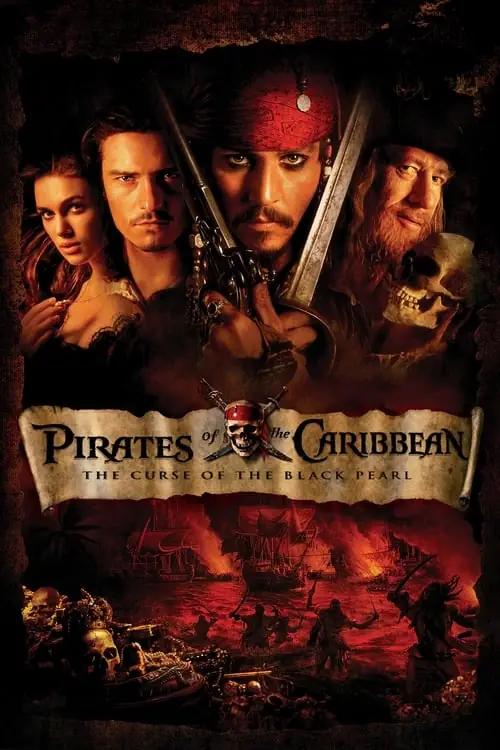
INT. GALLERY ROOM — HORROR · SHADOW GALLERY — DAY
Gore Verbinski's 2003 maritime adventure represents a singular achievement in blockbuster filmmaking: a work that resurrected a genre long presumed dead—the swashbuckler—and infused it with such kinetic energy, mythic resonance, and sheer cinematic joy that it recalibrated audience expectations for what a summer tentpole could achieve. Built upon the foundation of a Disney theme park attraction, the film transcends its corporate origins through the alchemy of exceptional craft and inspired performance. Johnny Depp's Captain Jack Sparrow immediately entered the pantheon of iconic screen characters, a creation of such eccentric brilliance that it permanently altered the trajectory of the actor's career. Depp constructs Sparrow as a figure of perpetual ambiguity—his moral compass spinning wildly, his loyalties shifting like sand beneath tide—yet the performance never descends into mere quirk for its own sake. There is genuine intelligence in the way Sparrow manipulates every situation, his apparent drunkenness masking a strategic mind that perpetually calculates odds and angles. Verbinski's direction demonstrates a remarkable understanding of spatial geography within action sequences; every sword fight, cannon barrage, and ship-to-ship engagement unfolds with a clarity that makes the most complex set pieces feel effortlessly legible. Dariusz Wolski's cinematography bathes the proceedings in a palette of burnished golds, deep oceanic blues, and the silver luminescence of moonlight—the latter serving a crucial narrative function in rendering the skeletal forms of the cursed pirates visible. The film's thematic architecture is more sophisticated than its popcorn-entertainment trappings might suggest. It meditates on the nature of freedom versus obligation, the cost of desire, and the paradox of immortality as a curse rather than a blessing. The cursed crew of the Black Pearl, incapable of tasting food or feeling the warmth of human connection, serve as a haunting metaphor for the hollowing effect of unchecked avarice. Keira Knightley's Elizabeth Swann and Orlando Bloom's Will Turner provide the romantic and heroic counterweight to Sparrow's moral vagrancy, their earnestness never feeling like a weakness but rather a necessary anchor in the film's swirling moral currents. Klaus Badelt's score, built around themes developed with Hans Zimmer, achieves that rare synthesis of melody and momentum that elevates every scene it touches. Two decades after its release, the film's craftsmanship remains astonishing—the practical effects, the tangible weight of the ships, the commitment to physical performance in an era increasingly dominated by digital artifice. It is a rare film that manages to be simultaneously a perfect entertainment and a work of genuine artistic ambition, and it remains the high-water mark against which all subsequent entries in the franchise have been measured—and found wanting.
Source Reference
Original archive log: https://www.themoviedb.org/movie/22?language=en-US