INT. GALLERY ROOM — HORROR · SHADOW GALLERY — DAY
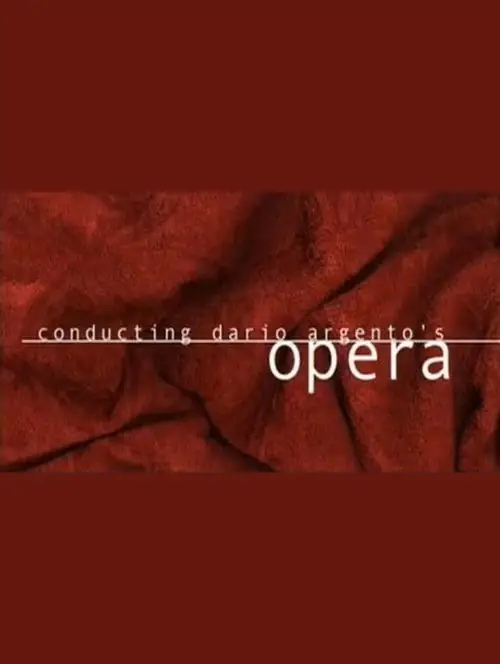
The documentary form, when applied to cinema itself, inhabits a peculiar epistemological position—simultaneously inside and outside its subject, offering access while inevitably mediating it. Conducting Dario Argento's 'Opera', produced as supplementary material for the 2001 limited edition DVD release of the maestro's 1987 giallo masterpiece, exemplifies the behind-the-scenes documentary as a mode of critical illumination. The film directs its gaze at the production history of one of Argento's most formally audacious works, a film that represents both the culmination of his visual experimentation and, in retrospect, the beginning of the decline of his commercial fortunes. The documentary's value lies not in comprehensive coverage—the constraints of DVD supplement runtime preclude the exhaustive treatment that a feature-length documentary might provide—but in the concentrated insight it offers into the working methods of a director whose formal imagination has few rivals in the history of horror cinema.
Argento's Opera occupies a singular position within his filmography, synthesizing the baroque visual excess of his earlier gialli with the operatic grandeur that the title declares. The documentary traces the film's conception and execution with particular attention to the formal innovations that distinguish it: the virtuosic crane shots, the first-person camera that forces audience identification with the killer's gaze, the infamous sequence in which the protagonist is bound and forced to watch violence through needles taped beneath her eyes—a device that functions as a savage metacommentary on the spectator's own complicity in the spectacle of cinematic violence. The documentary's interviews with cast and crew members reveal the technical challenges behind these sequences, the practical ingenuity required to realize Argento's uncompromising vision on a budget that, while substantial by Italian standards, required constant improvisation and adaptation. The testimony of the collaborators paints a portrait of a director whose aesthetic demands were absolute, whose willingness to sacrifice comfort, schedule, and occasionally safety to the imperatives of the image marked him as an artist of singular, sometimes terrifying, dedication.
CUT TO: THE WORK UNFOLDS
The documentary's most compelling contribution to the critical discourse surrounding Argento's work is its attention to the film's relationship to the operatic tradition that provides its setting and thematic framework. Opera, the film, is set in the world of a production of Verdi's Macbeth, and the documentary explores how Argento's long-standing fascination with opera—his father was a film producer, but the director's cultural formation was saturated with the operatic tradition that defines Italian artistic identity—informs the film's aesthetic strategies. The equation of operatic convention with the stylized violence of the giallo tradition is not merely a clever conceit but a genuine critical insight: both forms organize extreme emotional states through highly formalized conventions, both demand a suspension of naturalistic expectation in favor of intensified, stylized expression, and both traffic in the spectacle of suffering as a route to catharsis. The documentary's exploration of these connections elevates it from mere promotional material to a substantive contribution to the understanding of Argento's artistic project.
Conducting Dario Argento's 'Opera' ultimately serves as a time capsule of a particular moment in the evolution of film culture—the DVD era's investment in supplementary materials as a mode of cinephilic education, the construction of the director as auteur through paratextual apparatus, the growing appetite for access to production processes that the internet would eventually satisfy through other means. The documentary's existence as a supplement to a specific physical release, rather than as a standalone work, conditions its form and function: it assumes an audience already committed to the film it documents, and it can therefore dispense with the introductory material that a broader documentary would require. This specificity is a strength rather than a limitation, allowing the film to pursue its inquiry with the focus and intensity appropriate to its subject—a director whose own work has never compromised its vision for the sake of accessibility.
Source Reference
Original archive log: https://www.themoviedb.org/movie/168009?language=en-US