INT. GALLERY ROOM — SCI-FI · TOMORROW'S FRAME — DAY
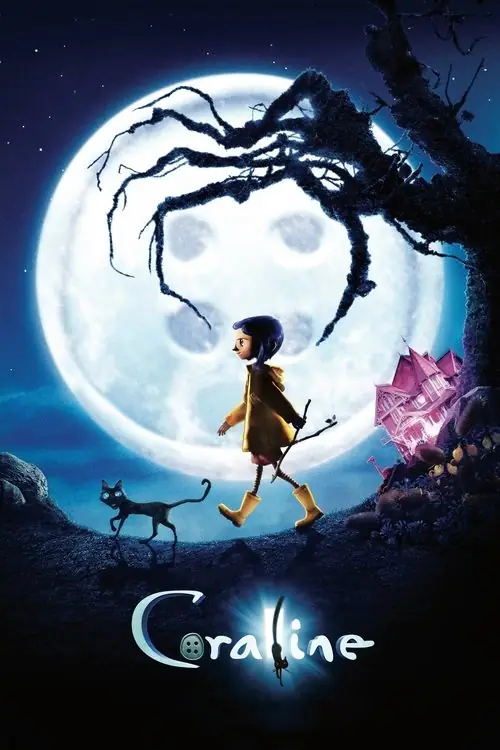
Henry Selick's Coraline represents a pinnacle of stop-motion animation as a medium for psychological horror, a film whose meticulous craftsmanship serves as the vehicle for a narrative of genuinely unsettling power. Adapted from Neil Gaiman's novella, the film follows its eleven-year-old protagonist through a portal into an alternate reality where her distracted parents are replaced by attentive doppelgängers with sewn-on button eyes—a conceit that functions as a devastating allegory for the seductive logic of wish-fulfillment and the terror that lurks beneath its surface. Selick, whose previous work on The Nightmare Before Christmas established his credentials as a master of the macabre, here pushes the expressive possibilities of stop-motion into territory that is at once more intimate and more disturbing, the handmade quality of the animation paradoxically amplifying rather than diminishing the story's capacity to unsettle. Every frame of the film bears the visible trace of human labor—the hand-stitched costumes, the painstakingly fabricated miniature environments, the infinitesimal adjustments of armature and expression—and this materiality generates a tactile unease that computer-generated imagery, for all its technical prowess, cannot replicate.
The film's visual design operates on a principle of doubling and distortion that mirrors its narrative architecture. The Other World initially presents itself as a heightened, more vivid version of the protagonist's drab reality—colors are more saturated, gardens more fantastical, performances more spectacular—but Selick seeds this paradise with subtle wrongness from the outset. The button eyes of the Other Mother and Other Father, which might seem merely whimsical, function as a masterful visual motif: they are simultaneously blank and watchful, denying the expressiveness of the human gaze while suggesting an omnipresent surveillance. The production design by means of a deliberately unsettling color palette gradually shifts from the warm, inviting tones of the initial seduction to the sickly greens and purples of the beldam's true domain, a chromatic descent that maps precisely onto the protagonist's psychological journey from enchantment to terror. The 3D cinematography, employed here with rare artistic purpose rather than mere gimmickry, uses depth to emphasize the vertiginous spaces between worlds and the claustrophobic constriction of the beldam's lair.
CUT TO: THE WORK UNFOLDS
At the thematic level, Coraline operates as a remarkably sophisticated meditation on the developmental psychology of childhood. The film understands that the transition from the latency period to adolescence involves a necessary disillusionment—the recognition that parents are limited, fallible beings whose attention is finite and whose love, however genuine, cannot completely satisfy the child's hunger for recognition. The Other Mother represents the fantasy of the perfectly attuned caregiver, the parent who exists solely for the child's gratification, and the film's horror derives from its unflinching demonstration that such a fantasy, if realized, would constitute not paradise but prison. The button eyes are the price of this perfect attention: the surrender of authentic vision, the exchange of genuine relationship for the narcissistic mirroring of a caregiver who sees you only as an extension of her own needs. This is psychological insight of a depth rarely encountered in animated cinema, and Selick presents it with a clarity that honors the intelligence of his young audience while offering adult viewers an experience of genuine complexity.
The cultural significance of Coraline extends beyond its achievements as a work of art into the broader conversation about the possibilities of animation as a medium. In an era dominated by the house style of Pixar and its imitators, the film stands as a defiant assertion of an alternative tradition—the lineage of European puppet animation, of Eastern European surrealism, of the handmade and the uncanny. Its commercial success and enduring critical reputation demonstrate that audiences, including children, possess a capacity for darkness and complexity that the entertainment industry systematically underestimates. The film's emotional resonance derives ultimately from its affirmation that the imperfect, the frustrating, the merely human—the parents who burn the dinner and forget to buy the gloves—are preferable to the seductive perfection of fantasy, and that growing up means learning to love the world as it is rather than as we wish it to be.
Source Reference
Original archive log: https://www.themoviedb.org/movie/14836?language=en-US