INT. GALLERY ROOM — SCI-FI · TOMORROW'S FRAME — DAY
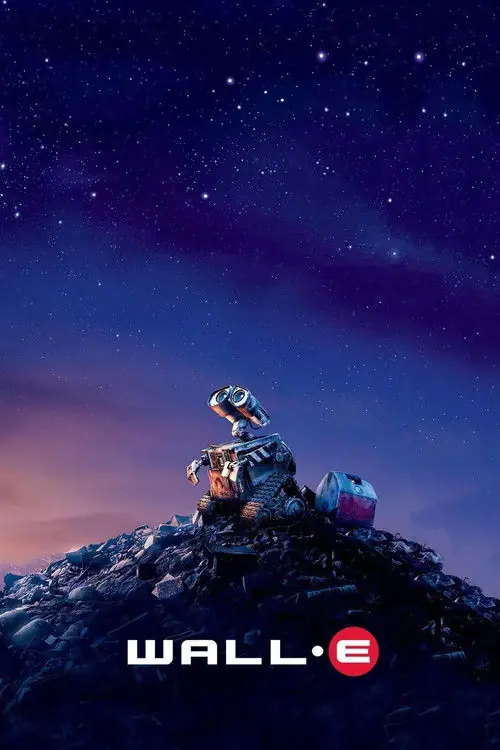
Andrew Stanton's WALL·E represents one of those rare moments in animation history when a major studio entrusts its considerable resources to a vision of almost radical quietude. For extended stretches, the film operates as a near-silent work, its protagonist communicating through a vocabulary of mechanical chirps, expressive ocular movements, and the eloquent body language of a rusted cube whose very design seems to incarnate loneliness. The premise—a solitary waste-compaction robot left behind on an abandoned, trash-choked Earth—is the stuff of Beckett or Tarkovsky, yet Pixar transforms this existential desolation into the vehicle for a love story of astonishing tenderness and a parable about environmental stewardship that never tips into preachiness. The visual world-building in the opening act is a masterwork of environmental storytelling. The planetary surface is rendered as a landscape of towering garbage skyscrapers, the detritus of consumer civilization stacked into monuments to its own excess. Amid this desolation, WALL·E executes his Sisyphean labor with a diligence that is simultaneously heartbreaking and inspirational. The animators invest this mechanical figure with a depth of personality that rivals any live-action performance: the way he sorts through human refuse and curates his collection of cherished artifacts—a spork, a Rubik's cube, a VHS copy of Hello, Dolly!—speaks to a yearning for connection and meaning that is unmistakably, poignantly human. The arrival of EVE, a sleek reconnaissance probe whose design language is the anti-thesis of WALL·E's industrial clunkiness, initiates a courtship that unfolds with the delicacy of a classic romantic comedy, conducted almost entirely without dialogue. The film's second movement, aboard the Axiom—a generational starship where humanity has devolved into a state of techno-infantilism—shifts registers into satirical science fiction. The depiction of passengers who have lost the capacity for autonomous movement, insulated from genuine experience by a perpetual stream of holographic convenience, constitutes one of the most mordant critiques of consumer technology ever smuggled into a family film. Stanton's direction ensures that the satire never overwhelms the emotional stakes; the humans remain figures of potential redemption rather than objects of contempt, and the film's ultimate argument is that the capacity for meaningful connection—with each other, with the natural world, with the labor of tending to something beyond oneself—can be recovered, no matter how thoroughly it has been surrendered. Thomas Newman's score deserves special acknowledgment for threading the film's tonal shifts with extraordinary precision. The music moves from the lonely keyboard figures that accompany WALL·E's solitary existence to the lush orchestral swells that underscore the film's cosmic romanticism, all while maintaining a coherent emotional signature. The film's conclusion, which resists the easy solution of simply returning to a miraculously restored Earth, insists instead on the harder truth: that ecological recovery requires collective effort, that the work of restoration is never finished, and that love—whether between two robots or between a species and its home planet—is ultimately a practice, not a feeling. WALL·E remains a towering achievement, a film that proves animation can be a vehicle for the most serious and sustaining of artistic ambitions.
Source Reference
Original archive log: https://www.themoviedb.org/movie/10681?language=en-US