INT. GALLERY ROOM — SCI-FI · TOMORROW'S FRAME — DAY
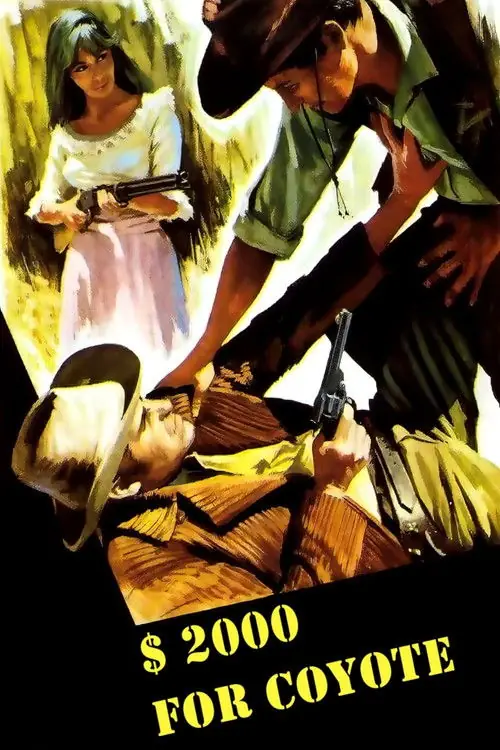
In the vast and varied terrain of the European Western, certain films achieve a kind of mythic compression—stories stripped to their moral essentials, where the landscape itself becomes a character and every glance carries the weight of existential consequence. This Spanish-Italian co-production, whose original title translates more evocatively as "Two Thousand Dollars for Coyote," occupies that lean, sun-scorched territory where the spaghetti western tradition intersects with a more contemplative, almost Hawksian examination of the bonds between men tested by circumstance. Sam Foster, the bounty hunter at the film's center, is wounded in a gunfight and finds refuge at a remote farmstead occupied by two brothers, Jimmy and Mary. The dynamic that unfolds in this isolated domestic space—the nursing of wounds, the sharing of meals, the tentative emergence of something resembling friendship—constitutes the film's moral fulcrum, the quiet before the inevitable storm of conflicting loyalties.
The film's true subject is the unbearable tension between personal obligation and professional duty, rendered with a starkness that belies the modesty of its production. Sam's gradual discovery that Jimmy, the man who has shown him kindness and shelter, is himself one of the outlaws Sam has been tracking, transforms the narrative from a simple chase into a tragedy of recognition. The bounty hunter's code demands that he fulfill his contract, that the price on a man's head be collected regardless of the texture of the relationship that has developed. But the film, to its credit, does not treat this code as inviolable. Instead, it interrogates the very notion of the bounty hunter as a moral actor: is Sam an agent of justice or merely a mercenary for whom the dollar amount is the only calculus that matters? The film's title, with its cold specificity, suggests the latter, but the narrative itself resists such easy conclusions, locating in Sam's dilemma a genuine anguish that the genre often elides in favor of stoic posturing.
CUT TO: THE WORK UNFOLDS
The visual grammar of the film draws from the deep well of the European Western tradition—the extreme long shots that dwarf human figures against the indifferent vastness of the landscape, the tight close-ups that isolate eyes and mouths in frames of almost unbearable intimacy, the dusty, desaturated palette that renders the world in shades of ochre and umber. The farmhouse, with its rough-hewn timbers and sparse furnishings, becomes a kind of stage upon which the drama of loyalty and betrayal plays out with theatrical concentration. The director demonstrates a particular sensitivity to the rhythms of rural life, the small rituals of labor and sustenance that form the unspoken language of the brothers' existence. These moments of domestic quietude are not filler but counterpoint, the calm that makes the coming violence all the more devastating.
The relationship between Jimmy and Mary, the two brothers whose bond predates and will presumably survive Sam's intrusion, is sketched with an economy that nonetheless conveys a rich history of mutual dependence and unspoken love. Mary's role as caregiver and moral conscience—it is she who tends Sam's wounds, who voices the concern about Jimmy's associates, who represents the possibility of a life beyond the cycle of violence—gives the film a feminine presence that complicates its masculine terrain. The film's resolution, which I will not disclose, navigates the competing claims of friendship and justice with a moral seriousness that elevates the material above its generic origins. "Two Thousand Dollars for Coyote" may not be a lost masterpiece of the spaghetti western canon, but it is a work of genuine integrity, a film that understands that the western's most enduring subject is not the gunfight but the choice that precedes it—the moment when a man must decide what he values more than money, and what he is willing to sacrifice to prove it.
Source Reference
Original archive log: https://www.themoviedb.org/movie/102522?language=en-US